Subfloor relative humidity in Richland County regularly exceeds 70 percent during warm months, creating a direct vector for subterranean termites, wood-destroying beetles, and fungal decay under residential…
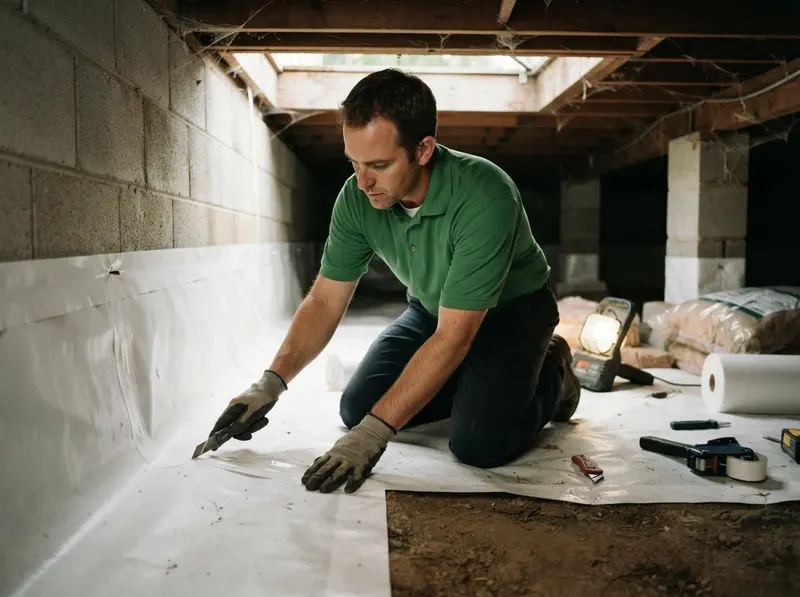
Subfloor relative humidity in Richland County regularly exceeds 70 percent during warm months, creating a direct vector for subterranean termites, wood-destroying beetles, and fungal decay under residential foundations. In older housing stock throughout Rosewood, Shandon, and Earlewood, open foundation vents pull humid ambient air directly beneath heart-pine subfloors. Under the stack effect, up to 50 percent of the air within a home's first floor is drawn directly out of the foundation cavity. Installing a reinforced ground vapor barrier isolates the foundation earth, preventing soil moisture from evaporating upward into floor joists, rim joists, and subfloor sheathing. LakeForge Exterminating deploys an engineering-grade structural envelope strategy that pairs physical poly sheeting with targeted pest exclusion rather than relying on recurring chemical ground drenches alone.
Material thickness dictates system longevity and puncturing resistance during service access. Standard ground coverings use 6-mil unreinforced sheeting that tears during basic plumbing maintenance, whereas commercial encapsulation mandates cross-laminated 12-mil, 16-mil, or 20-mil polyethylene sheeting anchored to perimeter masonry walls with mechanical fasteners and polyurethane sealant. In properties near Lake Katherine and Forest Acres, where high water tables saturate soil after heavy precipitation, sealing foundation walls and concrete piers prevents lateral water intrusion. The encapsulation envelope directly complies with specifications outlined in the Building Energy Codes Program and guidelines set forth by the Building Science Corporation regarding closed crawl space assemblies. Proper moisture regulation starves biological invaders of the liquid source required for colony establishment, functioning as a primary defense against Clemson Cooperative Extension documented subterranean termite foraging behavior.
Mechanical humidity regulation requires active monitoring. Once perimeter vents are sealed using high-density foam board and masonry closures, ambient humidity must be moderated by an energy-efficient subfloor dehumidifier draining directly to the exterior. Unregulated spaces risk fungal escalation if moisture remains trapped behind sealed vents without active extraction. Homeowners in historic Cottontown, Elmwood Park, and Olympia facing chronic cupping hardwoods or musty indoor air obtain relief by bringing crawl space equilibrium moisture content (EMC) below 14 percent, referencing standards from the USDA Forest Products Laboratory. The operational trade-off of closed encapsulation versus basic vapor retarders centers on capital expense versus structural security: simple 6-mil covers offer minimal moisture reduction and zero thermal control, whereas complete closed-envelope assemblies permanently stabilize framing integrity and eliminate subterranean insect shelter. Operational questions or structural evaluations are scheduled through LakeForge Exterminating at (839) 200-1113.
Every job gets a firm, written price after a free on-site visit.
Tell us about your crawl space encapsulation and moisture barrier service job in columbia and we'll send a clear, written quote, usually the same day.
 LakeForge Exterminating